Design Durable Profit.
The commercial architecture system for software-enabled solutions.
AI is rewriting the rules of software monetization. Per-seat subscriptions are breaking down. Hardware margins are thinning. The companies that design their commercial architecture now will set the terms. Everyone else will react.
I build and sell software
SaaS and software companies whose monetization model is under pressure from AI, competition, or investor expectations.
I make products with software
Manufacturers and device companies building profitable software revenue streams alongside physical products.
I practice SAFe/Agile
SPCs, agile coaches, and consultants who understand Value Streams and want to bring Profit Streams to the business side of their organizations.
Profit Streams™ covers the six dimensions that determine how your solution actually makes money — together. Across the entire solution lifecycle. Not just at launch.
Value Exchange • Pricing • Packaging • Licensing • Enforcement • Customer ROI
"We hired Applied Frameworks to help us redesign our pricing and packaging. The results have been amazing! CARR has increased by 35%, and new logos choosing an annual plan has increased from 20% to 65%, significantly improving cash flow and preparing us for our next phase of growth"
Our Clients Include:




Profit Streams™ are a team sport
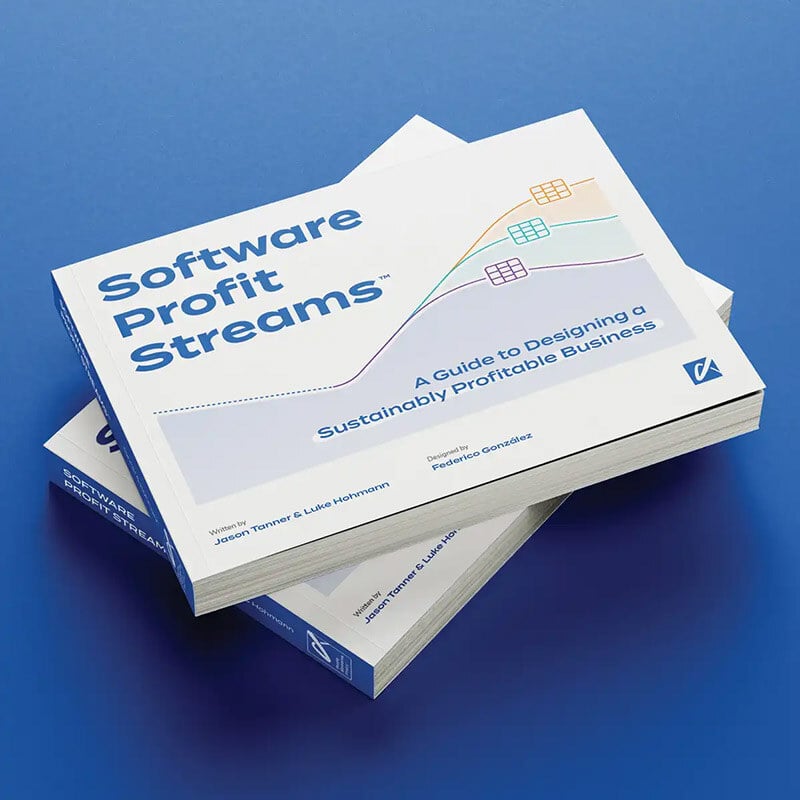
Both the Software Profit Streams book and the Profit Stream Canvas will help business leaders and teams involved in creating, pricing, selling, distributing, and licensing software-enabled solutions.
Design sustainable profit with Software Profit Streams™
-
-
Replaces the old, boring books on pricing with a visually stunning book and practical insights
Unlock sustainable profit with Software Profit Streams™
-
-
Replaces the old, boring books on pricing with a visually stunning book and practical insights
Access blogs, tools, and more to learn more about sustainable profitability.
Profit Streams Podcast
The Profit Streams™ Podcast evaluates business models for software-enabled solutions, pricing and licensing, packaging and positioning, and decision making patterns for our audience of business leaders, product leaders, and investors.
The Profit Stream Canvas
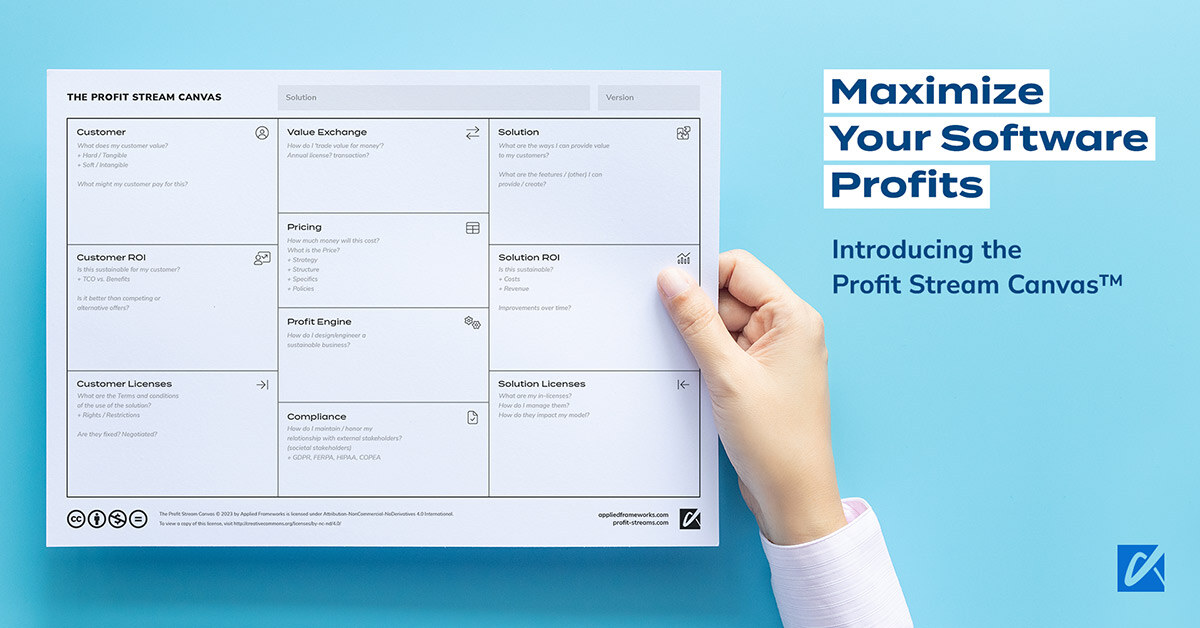
Nine questions, arranged on one page, for designing and evolving a Profit Stream — the specific way a solution creates and captures value for both customer and company.
Ten blocks, three columns.
The canvas is organized around the customer (left), the money (center), and the solution (right). Click any block to pin its questions.
Tap a block below to read what it asks →
Before the canvas, three ideas.
The canvas is a tool. These are the concepts it's built on.
Software-Enabled Solutions
Every software-enabled solution (SES) is made of up to four attributes working together:
- Software — the instructions, data, and programs that operate computers to perform a task
- Hardware — the chips, computers, and infrastructure required to run the software
- Services — people who use, complement, or enhance the software
- Data — what the SES generates through use, which can itself become a source of value
What a Profit Stream Is
A value stream is the sequence of activities an organization undertakes to design, produce, deliver, and maintain a solution for a customer. A Profit Stream is a value stream designed to create a sustainable business — it quantifies economic value, sells it through pricing and licensing choices, and ensures revenue exceeds cost across the solution lifecycle.
Value is the benefits a customer receives less their total cost of ownership.
Systems Thinking
Designing a sustainable SES means making — and remaking — a system of interdependent choices: a licensing term shapes a license agreement, which shapes compliance and data-retention choices, which the technical architecture must enforce.
The canvas takes that scattered network of choices and snaps it into one compact, three-column layout that promotes holistic thinking and collaboration.
Three ways a Profit Stream has to hold up.
Every block on the canvas ultimately serves one of these three, interdependent questions.
Solution Sustainability
Customers receive a continuous flow of value, timed to their needs and enabled — or constrained — by technical choices, compliance requirements, and other context. The Customer block starts here: understanding who your customer is, what benefits your solution provides, and how your strategy serves them over time.
Economic Sustainability
Your customer's assessment of value is greater than the price they've paid, and your revenue exceeds your costs to create, maintain, and operate the solution. Total Revenue must exceed Total Costs — and the solution must beat alternatives, including the status quo.
Relationship Sustainability
The legal agreements — contracts, terms of service, license agreements — that govern the interactions between the solution, customers, suppliers, and regulators promote mutually beneficial outcomes over the long term.
- Help me live a better life
- Entertainment and pleasure
- Experience
- Help me do my job
- Help me work with others
- Help me feel competent
- Lower costs, raise revenue
- Perform critical tasks
- Deliver a better customer experience
Software isn't hardware with extra steps.
Companies that price and license software like a physical good run into trouble. Here are some of the book's twelve reasons why software is different — each one a place a Profit Stream can be built or broken. Tap to expand.
A license restricts what ownership rights transfer, if any — unlike a pen you buy and can hand to anyone.
Sometimes the customer supplies the hardware, sometimes the provider does, sometimes both — as with a SaaS product accessed from a personal computer.
Most software license agreements reject the kind of implied warranty that lets customers repair or modify physical goods, making "right to repair" a live licensing issue.
Distribution is nearly free; the real, often-underestimated costs are ongoing operation, maintenance, and eventual decommissioning.
In-licensed components carry their own agreements and business models that a Profit Stream depends on — and must periodically audit.
Unlike a couch or a lawnmower, software keeps getting upgraded in the customer's hands — opening new, ongoing ways to capture value and revenue.
Usage data can improve the solution, inform new Profit Streams, and even help customers change their own behavior — value a physical good alone can't create.
Four moments teams reach for the canvas.
Per Chapter 3, Section 1, every use of the canvas follows the same three-step pattern: identify what needs to change, work through its impact on other blocks, and keep going until every block is set.
New Solution Development
- Startups creating their first solution
- Established companies creating a new solution within a portfolio
- Established companies replacing an old solution with a software-enabled one
When Software Eats Hardware
- Traditional companies integrating software into an existing hardware product
- Pricing and licensing built for hardware often breaks under software's economics
- Twelve differences each open a new way to build a Profit Stream
Spinouts / Carve-outs
- Commercializing a private, internal solution into a Profit Stream
- The first customer is the entity that created the solution
- Best staffed as a new division — or a new company entirely
Solution Lifecycle Management
- Triggered by Time, External Triggers, and Internal Triggers
- Opens four opportunities: adjusting pricing, adjusting packaging, fine-tuning Profit Engines, adjusting compliance
- Growth-stage solutions should revisit pricing every 3–6 months; mature ones every 6–12
↳ identify → explore impact across blocks → all blocks working together
The canvas is one tool in a fog of uncertainty.
Business leaders navigate ahead using models and maps at different time horizons. Two of them: the Industry Lifecycle, which locates you in your market's arc, and seven navigation tools with the Profit Stream Canvas at the center.
Introduction
Startups creating a new industry. Highly volatile — many fail for being too early.
Growth
New companies become sustainable; weaker competitors fail, merge, or are acquired.
Maturity
Companies are well established and profits tend to be highest — often longer than expected.
Decline
The market's need for this set of solutions ends. Companies evolve to new industries or fail.
Ten blocks. One page.
Start designing your Profit Stream.
The Canvas is free. The companion templates are free. The sequence is proven.
Download the Canvas — free