
Design Durable Profit.
The commercial architecture system for software-enabled solutions.
AI is rewriting the rules of software monetization. Per-seat subscriptions are breaking down. Hardware margins are thinning. The companies that design their commercial architecture now will set the terms. Everyone else will react.
I build and sell software
SaaS and software companies whose monetization model is under pressure from AI, competition, or investor expectations.
I make products with software
Manufacturers and device companies building profitable software revenue streams alongside physical products.
I practice SAFe/Agile
SPCs, agile coaches, and consultants who understand Value Streams and want to bring Profit Streams to the business side of their organizations.
Profit Streams™ covers the six dimensions that determine how your solution actually makes money — together. Across the entire solution lifecycle. Not just at launch.
Value Exchange • Pricing • Packaging • Licensing • Enforcement • Customer ROI
"We hired Applied Frameworks to help us redesign our pricing and packaging. The results have been amazing! CARR has increased by 35%, and new logos choosing an annual plan has increased from 20% to 65%, significantly improving cash flow and preparing us for our next phase of growth"
Our Clients Include:










Profit Streams™ are a team sport
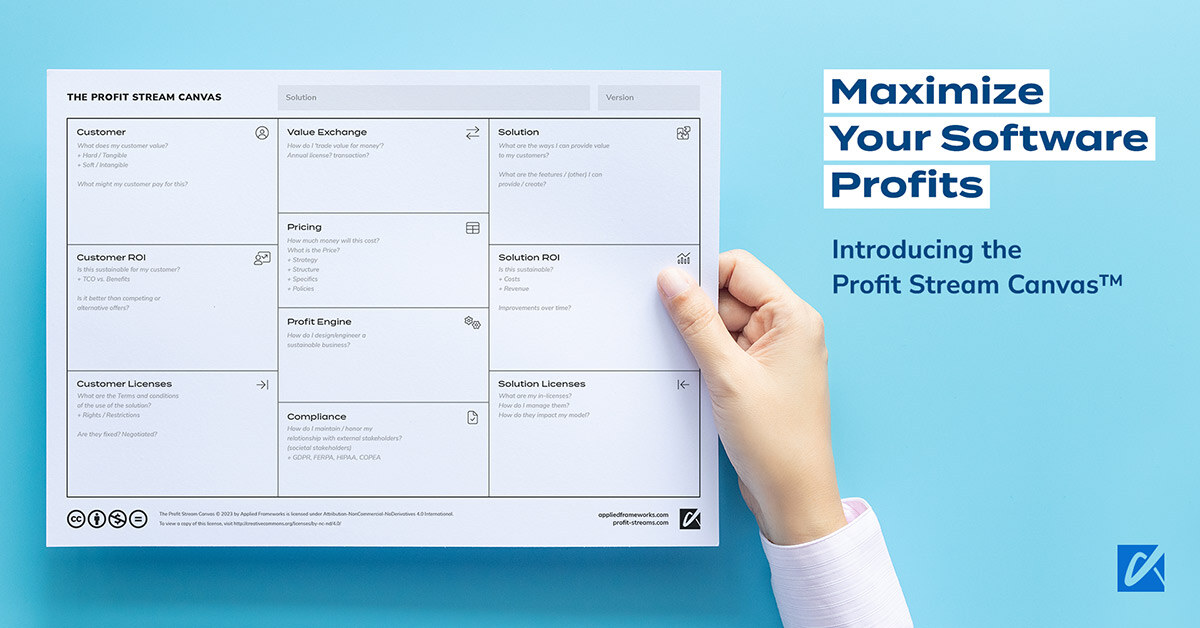
Both the Software Profit Streams book and the Profit Stream Canvas will help business leaders and teams involved in creating, pricing, selling, distributing, and licensing software-enabled solutions.
Design sustainable profit with Software Profit Streams™
-
-
Replaces the old, boring books on pricing with a visually stunning book and practical insights
Unlock sustainable profit with Software Profit Streams™
-
-
Replaces the old, boring books on pricing with a visually stunning book and practical insights

Access blogs, tools, and more to learn more about sustainable profitability.

Profit Streams Podcast
The Profit Streams™ Podcast evaluates business models for software-enabled solutions, pricing and licensing, packaging and positioning, and decision making patterns for our audience of business leaders, product leaders, and investors.
Drift
In most operating companies, commercial performance does not deteriorate suddenly. It erodes gradually.
Drift is the gradual misalignment between how a business creates value, how the market perceives that value, and how the commercial system captures it.
It is not a failure of effort. It is structural. And it is almost always already present by the time it becomes visible.
Drift rarely announces itself. It accumulates.
It becomes visible in transactions that, taken individually, appear manageable — but collectively form a pattern that signals misalignment.
Margin improvement becomes a recurring priority. Targets rise. Reviews intensify. Yet the pricing model and commercial structure remain largely unchanged. The pressure increases; the design does not.
Leadership calls for disciplined growth. Yet everyday deal structures, pricing practices, and terms reward alternative behavior. Transactions follow the signals embedded in the model, not the stated direction.
Offerings expand. Capabilities improve. Outcomes strengthen. But the pricing structure remains anchored to an earlier version of the product or service. Customers respond rationally to incentives that no longer match the value created.
As performance becomes harder to interpret, additional dashboards and controls are introduced. Reporting grows more detailed. Yet clarity does not improve proportionally.
Approvals increase. Special terms become routine. Workarounds are documented and normalized. The commercial system continues operating — but through accommodations rather than structure.
Drift is expensive because it distorts decision quality.
Revenue continues. Margin is reported. Activity remains high. But the signals leaders rely on no longer cleanly reflect economic reality.
Discounting, exceptions, and structural accommodations protect short-term revenue. But they obscure true willingness to pay and weaken pricing power over time. Reported performance holds. The underlying economics weaken.
When pricing no longer reflects value creation, transaction data stops telling a clean story. Decisions are made with more data, but less clarity.
If the pricing structure encourages cost containment rather than expansion, customer behavior reflects that design. Leadership may interpret slower expansion as a market problem, a product problem, or a sales execution issue — when the economic design itself is influencing behavior.
Time and management attention are consumed by approvals, overrides, and reconciliation. The organization becomes skilled at accommodation rather than alignment.
Drift does not produce immediate failure. It creates quiet economic friction. Revenue continues. Margin is reported. Activity remains high. But the feedback loop between value creation and monetization weakens. As that feedback loop weakens, decision quality declines.
The question is not whether Drift exists. The question is whether it is visible.
Start the diagnostic now.
These are not diagnostic tools for pricing specialists. They are questions any business leader can ask — and answer — in a single leadership conversation.
Recognizing Drift is the first step. Here is what comes next.
Drift is not fixed with a pricing tactic. It requires redesigning the commercial architecture — the complete system of how your business captures value. There are three ways to start, depending on where you are.
The design framework for rebuilding your commercial architecture. Free download. Six dimensions. Built for teams.
Download the Canvas →The step-by-step practitioner guide to running the initiative — from value model to customer migration. By Kevin McCabe.
Get the book →A Certified Profit Streams Designer or Trainer can guide your organization through the Canvas and the initiative. Global network.
Find a partner →Not theoretical. Developed through direct observation.
Drift reflects repeated patterns observed in operating companies — across industries, growth stages, and commercial models. In each case, the symptoms appeared different. The underlying dynamic was consistent. This framing was developed through direct observation of how commercial misalignment accumulates, and how it can be recognized before it requires a full reset.
Drift is part of the Profit Streams™ methodology, developed by Applied Frameworks. For the full intellectual framework behind the methodology, see Software Profit Streams by Luke Hohmann and Jason Tanner.
Download Drift as a designed PDF — for sharing with your leadership team, reading offline, or referencing in a board conversation.
Download Drift (PDF) →